Industrial Filament Workshop – Erasmus+ 3D Academy
As part of the Erasmus+ project “3D Academy”, students had the opportunity to visit a local technology company specializing in additive manufacturing and 3D printing solutions. The visit was organized as an educational activity aimed at helping participants better understand how modern 3D printing technologies are used in industry.
During the visit, the students took part in an Industrial Filament Workshop, where company experts introduced them to the fundamentals of filament-based 3D printing technologies. The workshop focused on Fused Filament Fabrication (FFF) printers and the wide range of materials that can be used in professional environments.
The session began with an overview of the different types of filaments commonly used in 3D printing. Students learned about materials such as PLA, which is widely used for educational and prototyping purposes due to its ease of printing and environmentally friendly properties. They also explored ABS, known for its durability and resistance to higher temperatures, often used in mechanical parts and industrial prototypes.
Another important material discussed was PETG, which combines strength, flexibility, and chemical resistance, making it suitable for functional parts. The workshop also presented more advanced industrial filaments such as Nylon, valued for its mechanical strength and wear resistance, and carbon fiber reinforced filaments, which provide high rigidity and lightweight properties for engineering applications.
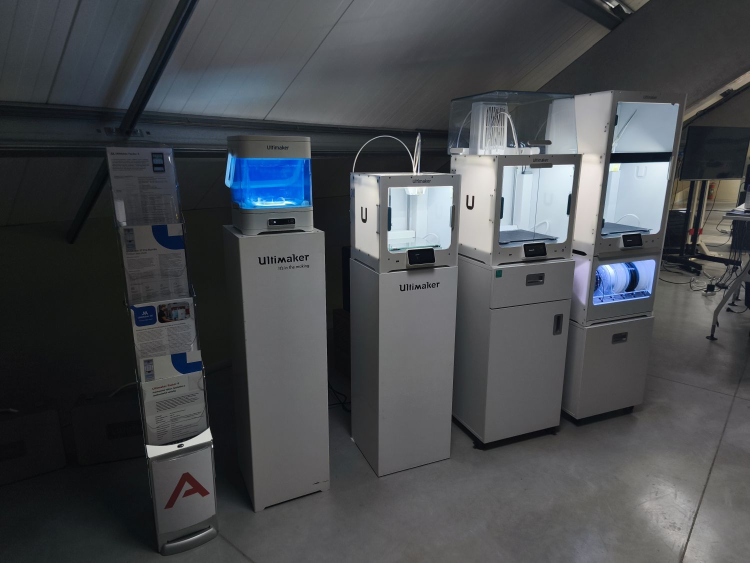
In addition to materials, the students were introduced to different sizes and types of filament-based 3D printers used in both educational and industrial environments. The company demonstrated several machines, ranging from desktop 3D printers, commonly used in schools and laboratories, to large-format industrial printers capable of producing much bigger objects with high precision.
Participants learned about key printer components such as extruders, heated beds, build volumes, and nozzle systems, as well as how machine size influences the types of projects that can be produced. Large industrial printers allow companies to manufacture bigger prototypes or functional components, while smaller machines are ideal for rapid prototyping and educational use.
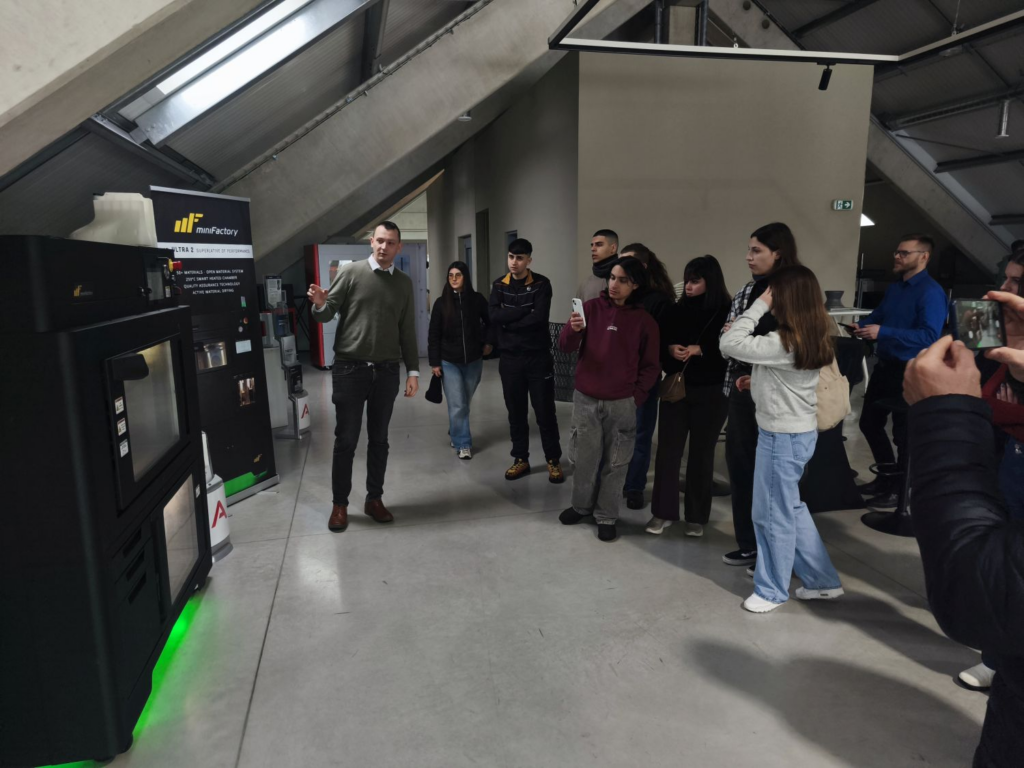
The workshop also included practical demonstrations showing how filaments are loaded into the machines, how printing parameters are configured, and how digital 3D models are transformed into physical objects layer by layer.
For the students of the 3D Academy Erasmus+ project, this visit was a valuable opportunity to connect theoretical knowledge with real industrial applications. It helped them better understand how additive manufacturing is transforming modern production processes and opening new possibilities in engineering, design, and manufacturing.
The experience inspired many participants and highlighted the importance of innovation, technology, and international collaboration within the Erasmus+ program.